3D Printing Services: SLA, SLS, MJF, SLM and FDM
Choose a printing process around what your prototype must demonstrate: appearance, assembly, functional behaviour or a complex geometry. KM Rapid has 200+ industrial 3D printers in Dongguan. SLA and FDM printing are carried out in-house. SLS, MJF and SLM metal printed parts are produced with qualified partner factories; KM Rapid handles DFM review, project management, quality inspection and delivery. Plastic printing supports concept models and product development, while SLM provides a metal printing route. Share your CAD file, intended use, quantity and material requirements so the process and finishing can be reviewed together. Contact us for lead time.
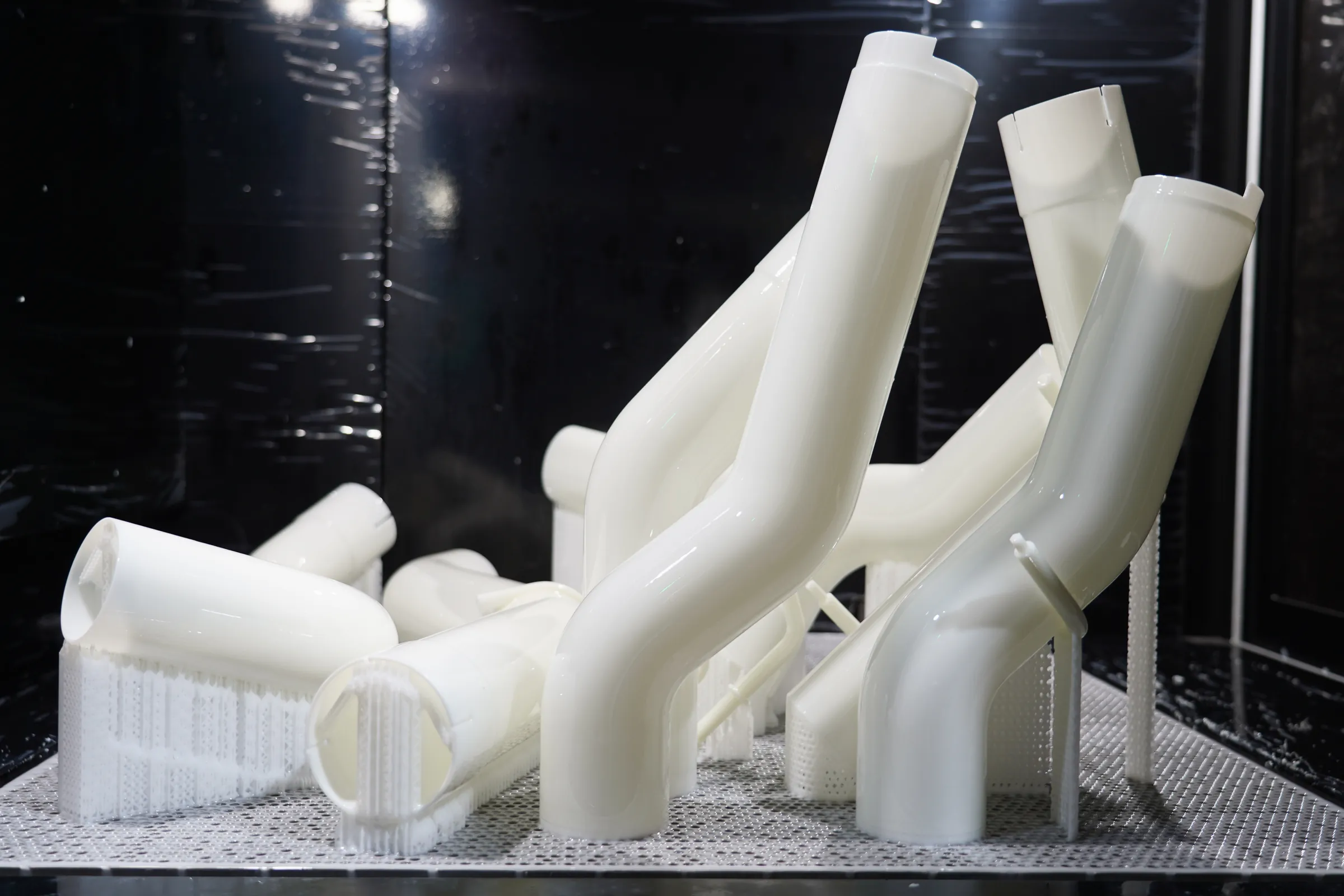
3D Printing Equipment
| Process | Production route | Typical use |
|---|---|---|
| SLA | In-house | Smooth, detailed resin prototypes |
| SLS | Qualified partner factories | Nylon functional parts |
| MJF | Qualified partner factories | Nylon functional parts and small batches |
| SLM | Qualified partner factories | Metal prototypes and complex metal parts |
| FDM | In-house | Concept models and larger prototype forms |
SLA: Detail and Surface Appearance
SLA printing in-house
Stereolithography uses light to cure liquid resin into a part, building the geometry layer by layer. It is a useful starting point for smooth, detailed prototypes and clear-part concepts. Support placement and subsequent surface preparation influence visible faces, so identify important appearance areas in the enquiry.
Typical parts include presentation housings, detailed form models and components for visual assembly reviews. Choose SLA when detail and appearance are central to the evaluation. Explain whether the part will be painted, viewed through or fitted to another component. Resin properties differ from those of injection molded thermoplastics; do not treat a similar material description as proof of equivalent strength, temperature resistance or service life.
SLS: Nylon Parts for Functional Evaluation
SLS parts are produced with qualified partner factories; KM Rapid handles DFM review, project management, quality inspection and delivery.
Selective laser sintering uses a laser to fuse selected regions of a polymer powder bed. The surrounding powder supports the part during building, which can help with complex shapes. Powder removal and access to enclosed features still need design attention. Nylon parts typically have a different surface texture from smooth resin prototypes.
Typical applications include brackets, ducts, housings and parts used to explore assembly or movement. Choose SLS when nylon behaviour and geometrical freedom are useful to your test. Discuss loads, contact surfaces and any flexible features before choosing a material. Specify whether surface appearance or dimensional interfaces need additional attention; printed geometry alone does not establish suitability for a functional application.
MJF: Nylon Components and Repeated Parts
MJF parts are produced with qualified partner factories; KM Rapid handles DFM review, project management, quality inspection and delivery.
Multi Jet Fusion uses fusing and detailing agents with thermal energy to form parts in a polymer powder bed. It offers another route for nylon components and small batches. Part orientation, cooling and powder removal affect planning, while functional requirements guide the material and finishing review.
Typical parts include enclosures, brackets, connectors and repeated assembly components. Choose MJF when you want to evaluate nylon parts across a batch or compare it with SLS for the same design. Provide the expected loads, mating features and required appearance. The preferred route depends on the complete project rather than the process name alone; confirm material availability and any inspection needs before ordering.
SLM: Complex Metal Prototypes
SLM parts are produced with qualified partner factories; KM Rapid handles DFM review, project management, quality inspection and delivery.
Selective laser melting builds metal parts by melting selected regions of metal powder with a laser. It can create geometry that is difficult to approach with conventional cutting tools. Supports, build orientation, powder access and subsequent operations must be considered as part of the design review.
Typical applications include complex metal prototypes, development brackets and parts that explore internal passage geometry. Choose SLM when metal is required and geometric freedom is a key reason to print. Specify the alloy and intended operating conditions for assessment. Critical mating surfaces may need a separate machining discussion. Printing a metal shape does not by itself establish fatigue performance, certification or suitability for a safety-critical application.
FDM: Concept Models and Assembly Studies
FDM printing in-house
Fused deposition modeling deposits heated thermoplastic through a nozzle to build the part in layers. It can be a practical route for concept work and larger prototype forms. Layer direction, visible layer lines and support access should be considered when planning the model and the test.
Typical parts include ergonomic mock-ups, layout models and housings used to explore assembly access. Choose FDM when the main question concerns shape, space or a design revision. Specify the requested filament material and any functional requirements for review. A printed part can behave differently along different directions, so loading and orientation matter. Do not infer final production performance from a visual concept model alone.
From CAD File to an Agreed Process
Send the model with quantity, intended use and critical dimensions. Tell us which surfaces will be seen, loaded or connected to other parts. The review can then consider process, orientation, material and finishing together. Identify any inspection or reporting requirement before ordering. Contact us for lead time.
Printing, Machining or Casting?
Use CNC machining when the specified stock material and machined interfaces drive the requirement. Consider vacuum casting for repeated plastic prototypes made from a master model. Printing is useful for design changes and complex geometry; the right choice depends on what the prototype must prove.
Choose an SLA Resin for Your Prototype
These five Kings3D photopolymers offer different appearances for SLA prototypes. Start with the part’s intended use and compare the supplier data below. An ABS-like or acrylic-like description indicates a prototype simulation; it does not make the resin identical to ABS or PMMA.
KS158T
Kings3D · SLA photopolymer · Clear
Clear-part concepts, display models and visual assembly reviews.
Review the optical effect, wall geometry and finishing. Clear appearance is not an optical-grade or PMMA specification.
KS408A
Kings3D · SLA photopolymer · Opaque white
Housings, form models and detailed assembly prototypes.
An ABS-like photopolymer for prototyping; it is not injection-molded ABS. Assess the intended load and environment.
KS608A
Kings3D · SLA photopolymer · Pale yellow
Form and fit prototypes and detailed concept models.
Select against the application and supplier data. A grade name alone does not establish strength relative to another resin.
KS808-BK
Kings3D · SLA photopolymer · Carbon black
Black appearance prototypes and master-pattern development.
An ABS-like photopolymer. The listed specimen properties follow 90 minutes of UV post-cure; finishing and part geometry still matter.
KS908C
Kings3D · SLA photopolymer · Brown
Detailed models and master patterns, including footwear and art-model development.
Review fine features, support access and the intended pattern-making route. Application examples do not establish suitability for every part.
| Grade | Tensile strength (MPa) | Hardness (Shore D) | HDT (°C, 66 PSI) | Tg (°C) |
|---|---|---|---|---|
| KS158T | 25–30 | 72–78 | 50–60 | 55–70 |
| KS408A | 27–31 | 76–82 | 55–65 | 55–70 |
| KS608A | 25–30 | 76–82 | 58–68 | 55–70 |
| KS808-BK | 25–30 | 75–85 | 58–70 | 62–75 |
| KS908C | 25–30 | 74–80 | 58–68 | 55–70 |
Supplier typical values from the Kings3D technical data sheets, measured on UV-post-cured specimens. KS808-BK specifies 90 minutes of UV post-cure; the other four sheets do not specify a duration. Tensile strength: ASTM D638. Hardness: ASTM D2240, Shore D. Heat deflection temperature (HDT): ASTM D648 at 66 PSI. Glass transition temperature (Tg): DMA, E″ peak. These are specimen data, not guaranteed properties of a finished printed part. HDT and Tg are not continuous-use temperature ratings.
Supplier layer ranges are 0.10–0.15 mm for KS158T and KS908C, 0.05–0.15 mm for KS408A and KS608A, and 0.05–0.12 mm for KS808-BK. Layer thickness is a printing setting, not dimensional tolerance. The build and inspection requirements are assessed from your drawing.
Read the materials guide or the SLA process page, then send the CAD model, quantity, cosmetic requirements and intended test for selection advice.
Frequently Asked Questions
Can’t find your answer? Talk to our engineers.
-
Which 3D printing technologies do you have?
KM Rapid has 200+ industrial 3D printers. SLA and FDM printing are carried out in-house. SLS, MJF and SLM metal printed parts are produced with qualified partner factories; KM Rapid handles DFM review, project management, quality inspection and delivery.
-
Can you 3D print metal parts?
Yes. SLM metal printed parts are produced with qualified partner factories; KM Rapid handles DFM review, project management, quality inspection and delivery. Standard-precision CNC machining is carried out in-house; selected high-precision CNC work is produced with qualified partner factories.
-
Should I choose 3D printing or vacuum casting?
3D printing suits one-off prototypes and fast design changes. Vacuum casting suits small batches, typically up to about 50 parts, that need production-like materials and finishes. A common route is to 3D print the master model, then vacuum cast the batch.
Ready to Start Your Project?
Send your CAD file, quantity and intended use. Request an NDA if needed, and discuss material, inspection and finishing with the team. Contact us for lead time.